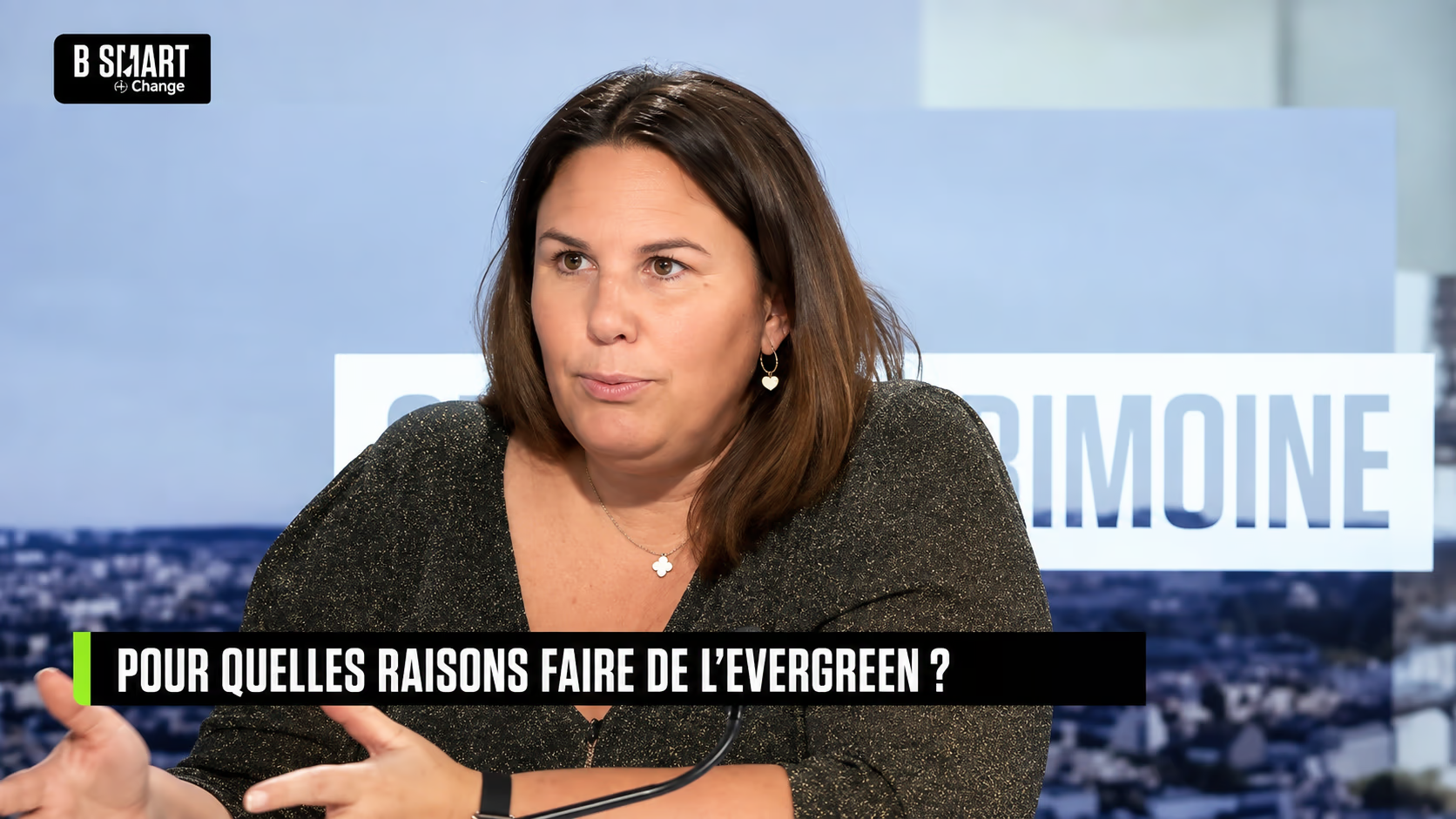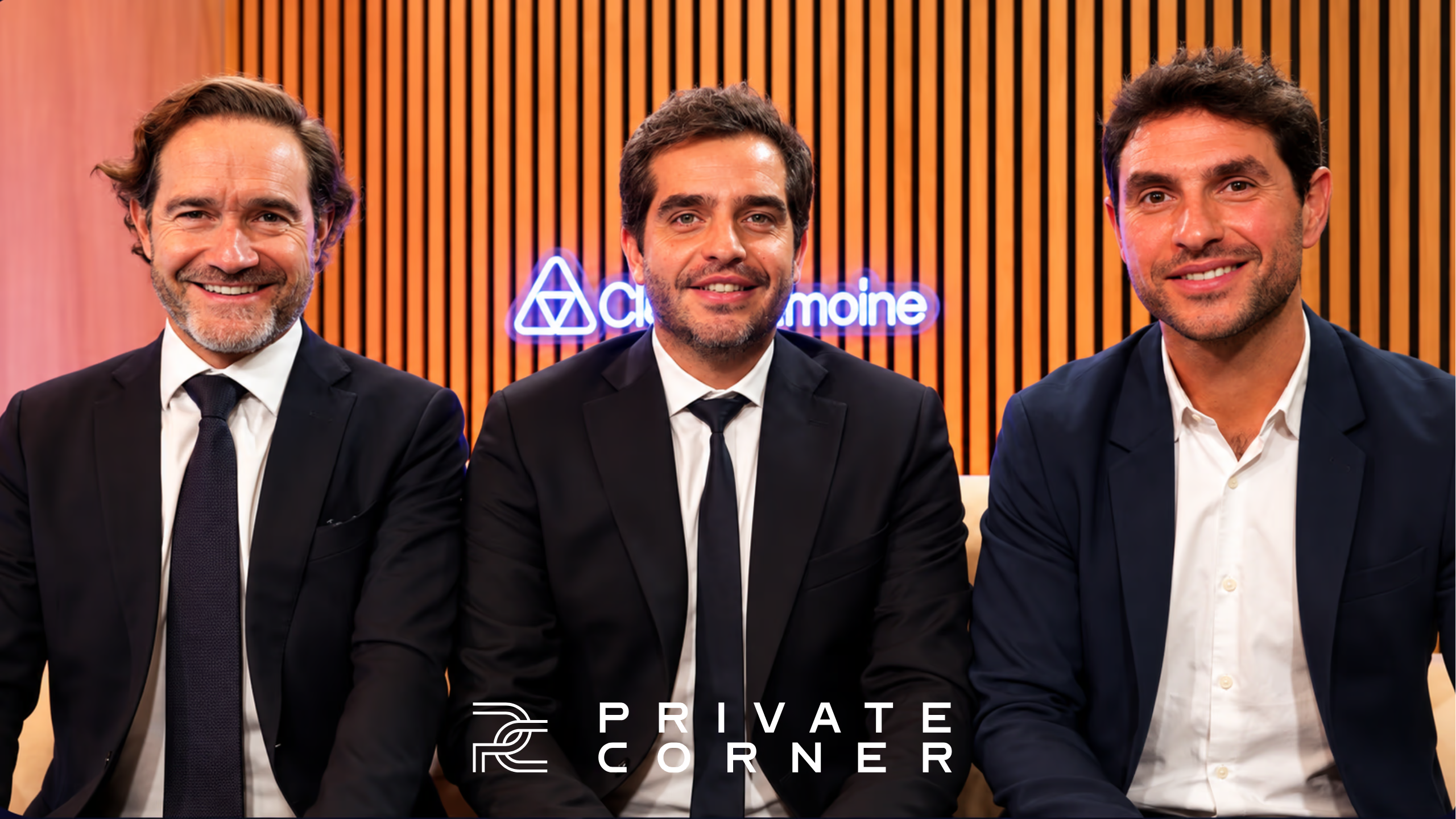
At Patrimonia 2026, Club Patrimoine hosted a round table moderated by Vincent Touraine, bringing together Maxime Vanneaux, Head of Partner Relations at Private Corner, Éric Coudert, Chairman of Financière de la Seine, and Matthieu Mancuso, Founder and Chairman of Egeo Conseil.
Our teams support wealth advisers, family offices and private banks in building their allocations.
What is Private Corner?
Private Corner is an independent asset management company, founded five years ago and 100% dedicated to private markets. Our business is to select managers in private equity, private debt and infrastructure, and then to structure feeder funds. Private wealth clients can thus access the expertise, management and track record of institutional managers from €100,000.
As of the date of the round table, we had raised €1.3 billion since our launch. For 2026, we aim to raise at least as much as in 2025.
How do you identify the strategies and managers that stand out?
Over the past four to five years, the asset class has opened up considerably, on both the investor and the manager side. We talk less about democratization than about professionalization: the challenge is to bring end clients up to institutional standards.
Our approach rests on three pillars:
- an in-house selection process and a team dedicated to manager analysis;
- a tailor-made structuring of products, which optimizes the fee model;
- cash management aimed at replicating the performance of the master fund as closely as possible in the feeder.
Our goal is to make private markets a lasting component of wealth allocation, not a one-off commercial operation.
Are private clients taking over from institutional investors?
While large institutions are now waiting for distributions before reinvesting, can private clients take over? For Maxime Vanneaux, that is not Private Corner's role: the firm is not meant to serve as a fundraising relay for managers who struggle to convince their historical LPs. Nor are we a catalog: we do not line up 10, 12 or 15 funds for the sake of it, but carry out genuine selection work followed by structuring.
Our funds offer geographic and thematic diversification, with products that complement those found on other platforms.
The market is also undergoing a paradigm shift: the way funds are managed and distributed is changing, with a need to match buyers and sellers and a slower velocity of capital than before. Some strategies, such as secondary private equity, address this constraint by design.
How do you build a diversified allocation around four funds?
We offer a permanent selection of 10 to 12 complementary funds, designed not to cannibalize one another. This shelf caters to all budgets, investment horizons and risk profiles, and makes it possible to build an overall private markets allocation from two types of building blocks.
"Core" building blocks
Highly diversified, they strengthen velocity:
- a secondary private equity fund managed by Committed Advisors;
- a private debt fund targeting annual coupon payments, without guarantee, which can gradually reduce the risk of the commitment. By receiving a return, investors gain confidence and can reallocate part of their savings.
"Satellite" solutions
More concentrated and more thematic, they generally target higher alpha, through two lenses:
- geographic: United States, Asia, Europe;
- thematic: environment, healthcare, tech.
What difference for a client investing from €20,000?
None in terms of selection and structuring quality. Our historical range, accessible from €100,000, is aimed at established wealth clients, with, for example, €500,000 to €700,000 in financial assets.
At the request of our distributors, we opened access to "emerging" wealth clients, who are younger and less endowed, without compromising on the same standards. Two products resulted:
- a closed-ended private equity fund of funds, diversified across managers, sectors and market capitalizations, accessible from €20,000;
- an evergreen infrastructure fund, structured as an ELTIF 2, accessible from €25,000.
Access to these funds remains subject to the eligibility conditions and minimum subscription amounts set out in each fund's documentation.
Private equity, private debt, infrastructure: 10 to 12 complementary funds, accessible from €20,000.
Why offer an evergreen infrastructure fund?
Infrastructure is a historical vertical for Private Corner: around €100 million has been raised there over five years with managers such as RGreen Invest, Antin Infrastructure Partners and EQT.
In early 2026, we launched an evergreen, i.e. perpetual, fund structured with Meridiam, a French manager that reports €27 billion in assets under management. It combines a long-term wrapper with a medium-to-long-term underlying portfolio. The strategy targets predictable cash flows and inflation protection, with no guarantee of results.
It relies on core and core-plus infrastructure: mature assets with revenues contracted through public-private partnerships.
As of the date of the round table, the average contract duration was 24 years, the portfolio comprised 22 assets, and the product had raised €30 million since the start of the year. The liquidity of an evergreen fund is restricted and not guaranteed: subscription and redemption terms are set out in the fund's documentation.
What is the real cost of a Private Corner fund?
We believe the business model must be fair and transparent: it should preserve as much value creation as possible for the end client, while remunerating Private Corner and our distributors. Our fee model is structured as follows:
| Share class | Annual management fee | Carried interest on Private Corner funds | Retrocession to partners |
|---|---|---|---|
| Clean share | 0.5% | None | No |
| Share class with retrocession | Up to 1.2% | None | Yes |
The clean share class is often included in Luxembourg-based wrappers. The underlying funds, for their part, provide for carried interest (performance fee), aligned with our clients' interests. This model applies to the €100,000 range as well as to the range accessible from €20,000.
These figures correspond only to the annual management fees of the relevant share class. The fees of the underlying funds, including carried interest, and any other fees are detailed in each fund's regulatory documentation, which should be reviewed before any subscription.
Can we still expect the performance of the past ten years?
In our view, private markets are uncorrelated with other asset classes, but not with the real economy: like the others, they have been hit by rising interest rates and inflation over the past three to four years.
Value creation has evolved. It no longer relies exclusively on a financial approach (buy and hold, leverage), but on an operational and transformational approach, focused on revenue and EBITDA growth.
Dispersion between managers, historically very low, is increasing and should continue to do so. Selection therefore becomes even more decisive, which, in our view, reinforces the legitimacy of a selector. However, no future performance can be guaranteed.
What share of financial wealth should be allocated to private markets?
There is no meaningful average. As a guide, the commonly accepted rule of thumb is around 20% of financial wealth, but it varies with the situation: a client with €300,000, another with €1 million, or an entrepreneur who has just sold their company do not have the same profile.
The range can go from 15% up to 30-35% for ultra high net worth clients whose financial wealth has increased sharply following a liquidity event, such as the sale of a business asset.
This indication does not constitute personalized advice: each allocation is defined with an adviser, based on the client's situation, objectives and investment horizon.
Conclusion – Selection, structuring and allocation
In a private markets universe that is broader but also more dispersed, Private Corner stands by a clear line: demanding selection, tailor-made structuring, fee transparency and core-satellite allocation. Choosing managers and building the portfolio matter more than simply gaining access to the asset class.
Investing in private markets involves risks, including capital loss, illiquidity and performance dispersion across funds.
Talk to our teams about fund selection and structuring for your clients.
FAQ – Private markets and the Private Corner range
What is the minimum ticket to invest with Private Corner?
Our historical range is accessible from €100,000. Two products open access from €20,000 for a closed-ended private equity fund of funds and from €25,000 for an evergreen infrastructure fund structured as an ELTIF 2.
What are the fees on Private Corner funds?
Annual management fees are 0.5% for the clean share class, and up to 1.2% for the share class that includes a retrocession to partners. Private Corner does not charge carried interest on its own structured funds, but the underlying funds provide for a performance fee. These fees do not include those of the underlying funds: all fees are detailed in each fund's documentation.
What is a core-satellite allocation in private markets?
It combines highly diversified core building blocks (secondary private equity, private debt) with more concentrated satellite solutions, either geographic (United States, Asia, Europe) or thematic (environment, healthcare, tech). A typical allocation includes two core and two satellite positions.
What is an evergreen fund?
An evergreen fund is a perpetual fund with no predetermined life. Private Corner's fund, structured with Meridiam, invests in core and core-plus infrastructure: mature assets with contracted revenues through public-private partnerships.
What share of financial wealth should be allocated to private markets?
The commonly accepted rule of thumb is around 20% of financial wealth, with a range of 15% to 30-35% for ultra high net worth clients who have experienced a liquidity event, such as the sale of a business. It varies with each client's situation.
What are the risks of investing in private markets?
The main risks are capital loss, illiquidity and performance dispersion across funds. Past performance is not indicative of future results.
This article is a promotional communication, published for information purposes by Private Corner, a portfolio management company authorized by the Autorité des marchés financiers (AMF) under number GP-20000038. It reflects the remarks made by Maxime Vanneaux during a round table organized by Club Patrimoine at Patrimonia 2026; the information it contains is given as of the date of that discussion and may change. It does not constitute investment advice, a personalized recommendation, or an offer or solicitation to subscribe to any product.
Funds managed by Private Corner are intended for professional investors or equivalent, or for clients advised by a regulated third party, subject to the eligibility conditions and minimum subscription amounts specific to each fund.
Investing in private markets (private equity, private debt, infrastructure) involves risks, including a risk of capital loss that may extend to the entire amount invested, an illiquidity risk (lock-up periods that may be long, redemptions that are restricted or limited), an asset valuation risk and a risk of performance dispersion across funds. No return or performance is guaranteed. Past performance is not indicative of future results.