Private equity is an asset class dedicated to financing and supporting private companies, with a long-term horizon, deferred liquidity and value creation that is first and foremost operational. This article is aimed at wealth advisors, family offices and sophisticated investors. It covers definitions, mechanics, strategies, risks and the investor profiles concerned.
Speak with the Private Corner team.
What is private equity?
Private equity: definition
Private equity is an asset class that consists of investing equity capital in private companies, with a long-term mindset, active engagement and operational value creation.
Unlike public markets, it relies on closed-end funds, deferred liquidity and performance that is built over time before it materialises. Long reserved for institutional investors, private equity is now accessible to sophisticated private investors through regulated vehicles, provided they understand its economic, legal and wealth-planning mechanics.
The difference between private equity and public market investments
The difference between private equity and public assets is both structural and conceptual.
Public markets offer permanent liquidity, but expose investors to high volatility, largely driven by capital flows and market sentiment. By contrast, private equity has no daily pricing and valuations are based on real economic criteria.
| Criterion | Private Equity | Public markets |
|---|---|---|
| Type of companies | Private | Listed |
| Horizon | Long term (8–12 years) | Short term / liquid |
| Liquidity | Low | Daily |
| Value creation | Operational | Financial |
| Volatility | Not observable | High |
"In private equity, time is not a risk to be managed: it is a performance lever."
The role of management companies and private equity funds
Management companies (General Partners – GPs) are at the heart of the model.
They do not simply allocate capital: they define an investment thesis, select companies, support management teams and organise exit conditions.
Private equity performance therefore depends mainly on:
- the quality of the management teams,
- their multi-vintage experience,
- their ability to execute a strategy across varied economic environments.
Key takeaway
In private equity, performance is first and foremost a matter of execution, not market timing.
This logic of value creation over several years is one of the fundamental characteristics of the asset class. To better understand what return to expect from private equity, it is worth studying historical performance, strategies and the dispersion between funds.
How does a private equity investment work?
The lifecycle of a private equity fund
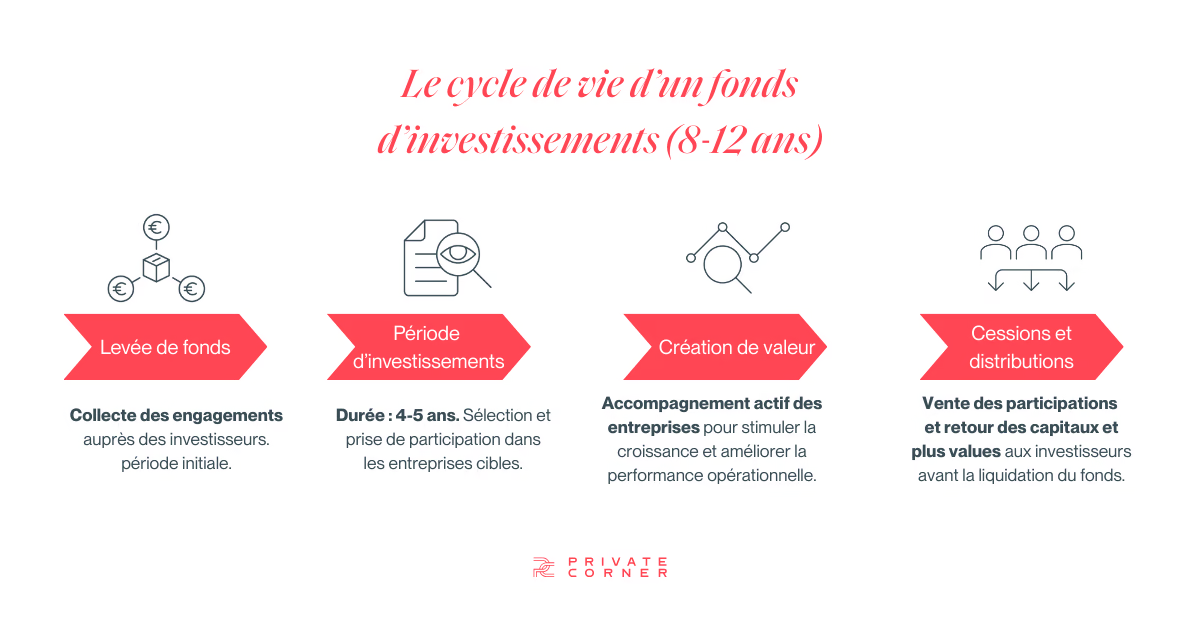
A private equity fund is a closed-end fund, structured for a term generally between 8 and 12 years, sometimes extended.
The investor commits to an overall amount (commitment), which is drawn down gradually as the fund makes its investments.
A fund's lifecycle unfolds in four phases:
- FundraisingCommitments are collected.
- Investment periodOver four to five years.
- Value creationActive support for companies.
- Exits and distributionsBefore the fund is wound up.
This timeline explains the J-curve dynamic, characteristic of private market funds.
From fundraising to exit: the key stages
Unlike a public market investment, capital is not invested immediately. Capital calls are gradual, often between 15 and 25% per year (sometimes more early in the fund's life).
Distributions, for their part, generally begin from the fifth year, as the first exits are completed.
It is important to stress that the investor commits to an amount, but that amount is rarely called in full. This mechanism creates cash flows spread over time, which must be built into the allocation from the outset.
The players in private equity: LPs, GPs and portfolio companies
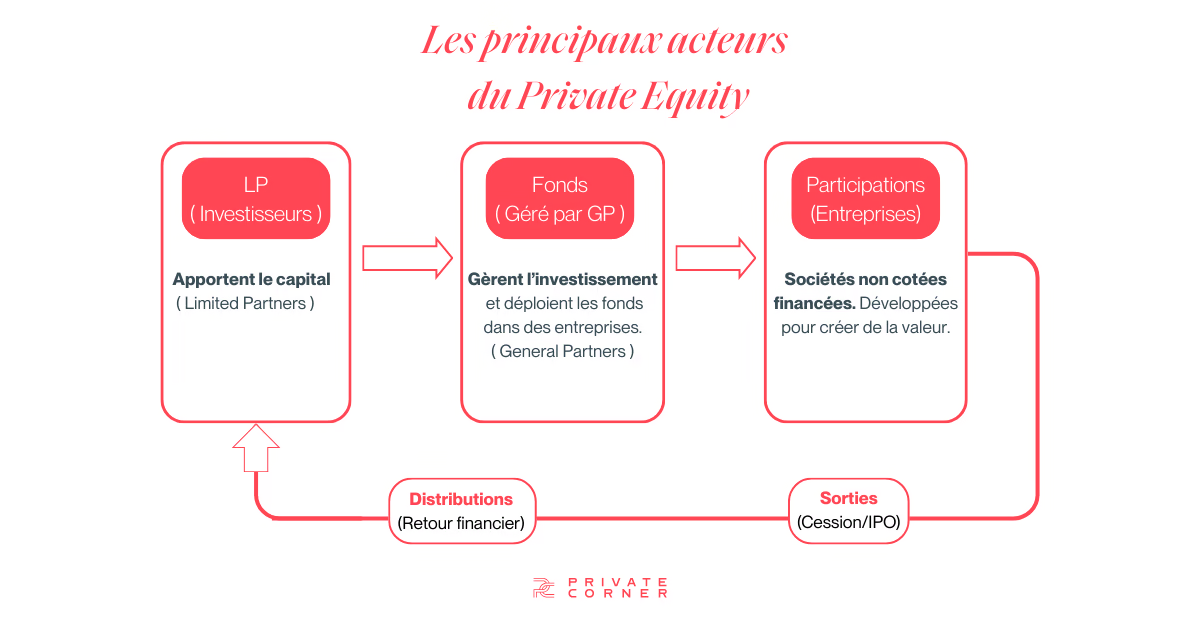
Private equity relies on a clearly identified chain of players:
- LPs (Limited Partners), who provide the capital;
- GPs (General Partners), who invest and manage it;
- companies, which are the engine of value creation.
Alignment of interests is reinforced by the GPs' personal investment in the funds they manage.
The different private equity strategies
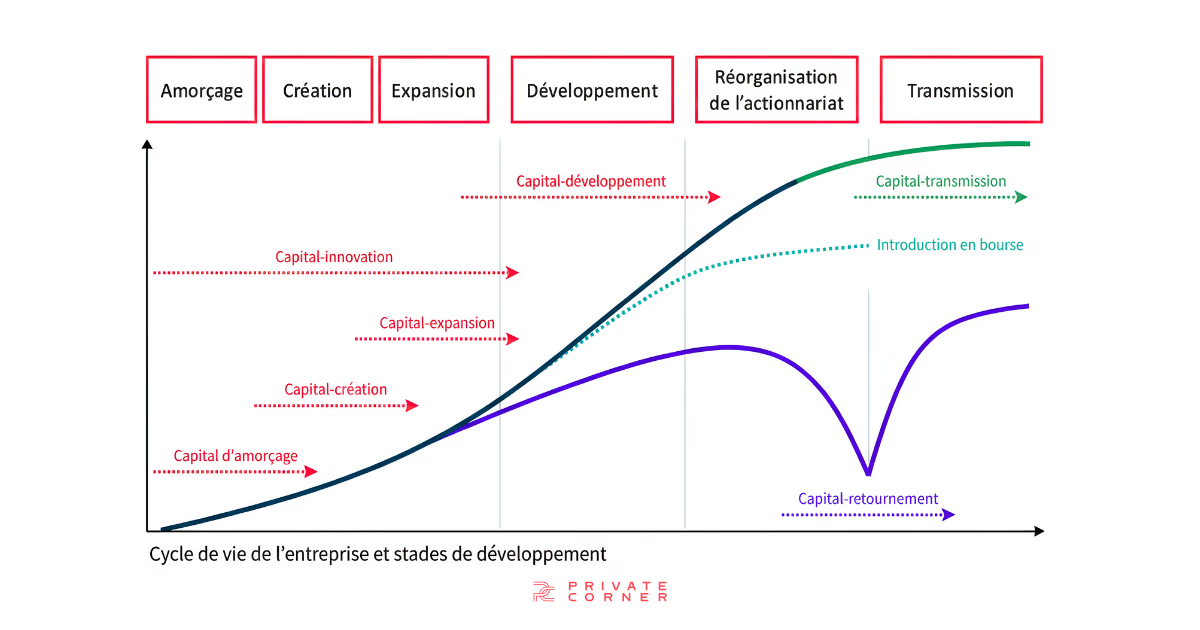
Venture capital: financing companies in their development phase
Venture capital finances young, innovative companies, often before they are profitable.
Risk is high and the dispersion of outcomes is significant, but the potential for value creation can be substantial when certain companies reach critical size.
Growth capital and buyout: growth and buy-out strategies
Growth capital is aimed at companies that are already profitable and wish to accelerate their development (international expansion, acquisitions, structuring).
Buyout capital supports the acquisition of mature companies, often through leveraged structures.
In these strategies, value creation rests mainly on operational improvement, governance and strategy, far more than on financial engineering.
Secondaries and co-investment in private equity
The secondary market allows investors to acquire existing portfolios, often with better visibility on the underlying assets and future cash flows.
Co-investment offers direct exposure to certain deals, alongside the main funds, generally at reduced fees.
Private equity, private debt, infrastructure: speak with our team.
A strategy is chosen according to: horizon, tolerance for illiquidity, level of risk, objective (growth, income, diversification), and the ability to diversify by vintage.
What is a private equity fund?
Structure and organisation of a private equity fund
A private equity fund is an Alternative Investment Fund (AIF), governed by the AIFM Directive and supervised by the AMF.
It centralises commitments, capital calls, distributions and reporting within a secure legal framework that meets institutional standards.
Types of funds: FCPR, professional funds and funds of funds
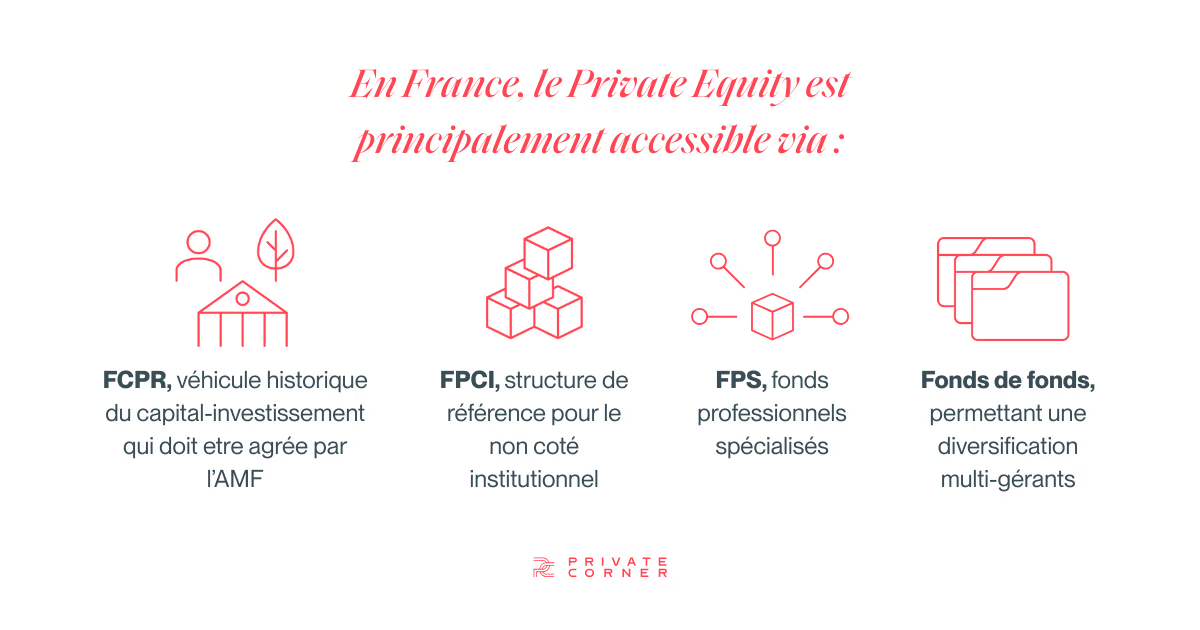
In France, private equity is mainly accessible through:
- FCPR (fonds communs de placement à risques), the historical private equity vehicle, which must be approved by the AMF;
- FPCI (professional private equity funds), the reference structure for institutional private markets;
- FPS (specialised professional funds);
- FIPS (specialised professional investment funds);
- Funds of funds, enabling multi-manager diversification.
The choice of vehicle determines taxation, governance, risk profile and liquidity.
To go further: our guide to investing in private markets details the different routes of access depending on the investor's profile.
Investment horizon and lock-up period
The investment horizon is a fundamental component of private equity.
A private equity investment takes place over the long term, which is necessary for companies to be genuinely transformed. This duration reflects the economic cycle of value creation, not an artificial constraint.
The counterpart of this timeframe is structural illiquidity. Funds are closed-end and do not offer redemption at the investor's initiative. However, this illiquidity must be understood in all its nuance: capital calls are gradual and distributions occur before the end of the cycle.
Key takeaway
The illiquidity of private equity is the condition for its ability to create lasting value.
Private equity in France and worldwide
€36.9bn
invested in private equity in France in 2024
€126bn
invested in private equity in Europe in 2024, up 24% vs 2023
The French private equity market: key figures
In 2024, private equity investments in France totalled €36.9bn (Source: France Invest / Grant Thornton, 2024). France is among the most dynamic European markets, with several tens of billions of euros invested each year in private companies. Private equity plays a central role in financing SMEs and mid-caps, business transfers and the structuring of entire sectors.
Billions of euros invested in Europe every year
Across Europe, €126 billion was invested in private equity in 2024, an increase of 24% compared with 2023 (Source: Invest Europe, 2024).
Institutional investors are allocating a growing share of their portfolios to this asset class, notably for its ability to generate performance over the long run.
The main sectors of private equity investment
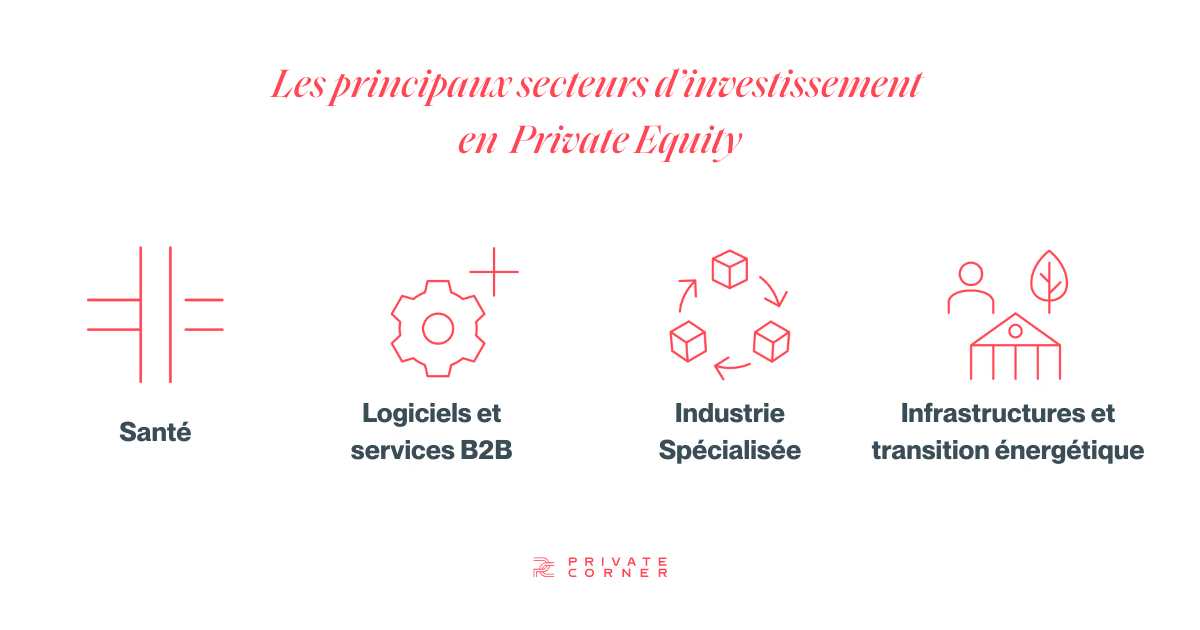
Investments are concentrated in high-potential sectors:
- healthcare,
- software and B2B services,
- specialised industry,
- infrastructure and the energy transition.
More broadly, funds aim to support the major transitions in healthcare, technology and the environment.
Why invest in private equity? The benefits
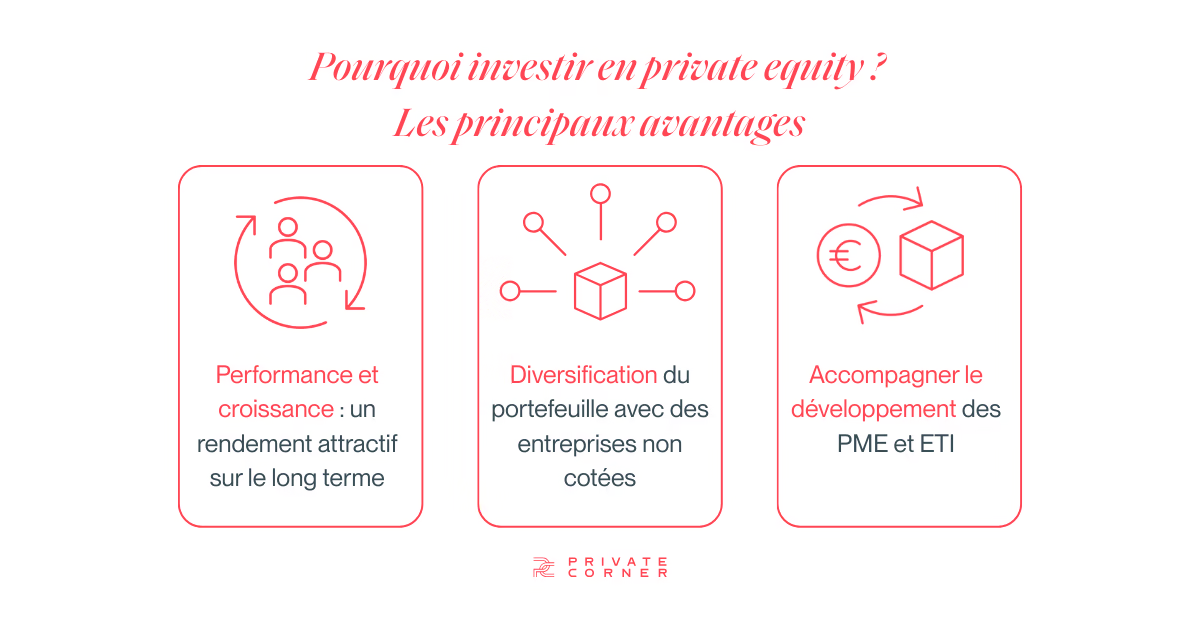
Performance and growth: an attractive long-term return
Private equity follows the logic of a structural wealth allocation, not the pursuit of opportunistic returns.
It enables endogenous value creation, based on the operational improvement of companies. It also provides structural, economic and temporal diversification relative to public markets.
As a cash-flow-based asset class, private equity can, over time, help self-finance commitments when distributions from mature funds offset new capital calls.
Portfolio diversification with private companies
The diversification provided by private equity should not be reduced to a mere statistical "decorrelation". It is structural, because it rests on performance drivers different from those of public markets.
First, investing in private companies gives access to a wider economic universe than the stock market: many value-creating SMEs and mid-caps are not listed, and some high-potential companies remain private for longer.
Private equity thus exposes the portfolio to growth trajectories and transformation situations that are absent from listed indices.
Next, diversification is also temporal. A portfolio built across several vintages (successive commitments) reduces single "entry point" risk. Each investment year captures a different valuation and cycle environment, which mechanically smooths timing risk.
Finally, diversification is economic and operational. Whereas the performance of listed assets can depend heavily on changes in multiples and market flows, private equity aims for more endogenous value creation: margin improvement, business model optimisation, external growth, governance structuring. This logic helps make the portfolio less dependent on a single performance factor.
Key takeaway
The diversification of private equity is a diversification of investment universe, of time and of value creation drivers, not just of assets.
Supporting the development of SMEs and mid-caps
One of the fundamental contributions of private equity is its ability to support the development of SMEs and mid-caps over the long term, well beyond simply providing capital.
Unlike traditional financing, private equity is based on a long-term partnership aligned with the strategic objectives of the companies it supports.
Private equity funds step in at key moments in a company's life: acceleration phases, governance structuring, shareholder transitions, operational transformation or sector consolidation.
At these stages, bank financing or public markets often prove unsuitable, too rigid or insufficiently patient.
The contribution of private equity is therefore twofold. It is first financial: strengthening equity, securing the balance sheet structure, and funding external growth or investment projects. It is then operational and strategic: providing sector expertise, structuring key functions, professionalising processes and supporting executives in decision-making.
This approach makes funds genuine industrial partners, able to support companies' scale-up over time. For the investor, this proximity to the real economy is a specific driver of value creation, based on the transformation of companies rather than on financial arbitrage.
Key takeaway
Investing in private equity means contributing to the development of SMEs and mid-caps: growth, transfer of ownership and transformation.
The risks of private equity you should know
Risk of capital loss and illiquidity of investments
Private equity carries a risk of partial or total loss of the capital invested. Private companies can be exposed to operational, sector-specific or macroeconomic uncertainties, and performance dispersion is higher than in public markets.
This risk is inseparable from long-term value creation. Private equity performance relies on the gradual transformation of companies, which implies greater short-term uncertainty, offset by return potential over time.
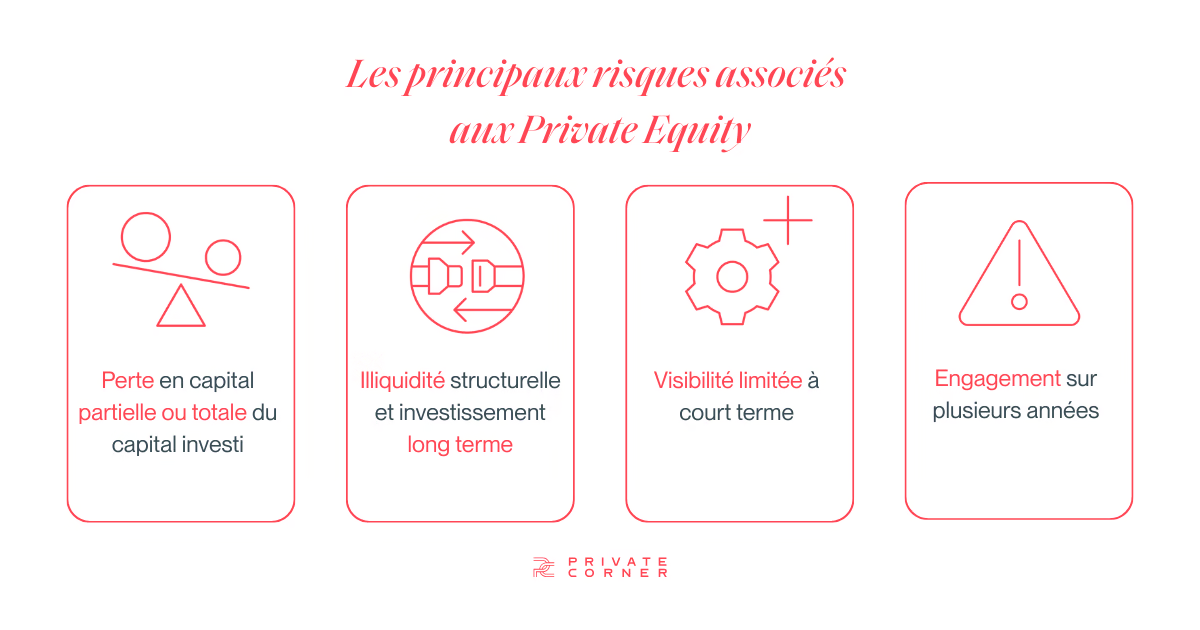
To this risk is added structural illiquidity. Private equity funds are closed-end: investors cannot request redemption of their units at any time. Exits depend exclusively on the timetable for selling the holdings.
This illiquidity should nevertheless be put in perspective. Capital calls are gradual, and distributions generally occur before the end of the fund's life, which spreads the effective lock-up of capital over time.
Key takeaway
Capital risk and illiquidity are the structural counterparts of private equity performance.
Long investment horizon and multi-year commitment
Investors must accept a prolonged lock-up of their capital and limited short-term visibility.
How to manage risks in private equity
Risk management relies on:
- diversification of strategies and vintages,
- rigorous selection of management companies,
- active management of cash flows.
Who can invest in private equity?
Institutional and professional investors
Private equity is primarily aimed at professional or sophisticated investors, able to understand its risks and constraints. Private equity is a complex, poorly standardised asset class, combining closed-end funds, successive capital calls, deferred distributions and specific legal structures. This complexity makes a stand-alone approach unsuitable.
The absence of liquidity and daily valuation calls for thorough upstream analysis (quality of the teams, fund structuring, alignment of interests) and long-term management of cash flows and allocation. Without support, there is a risk of miscalibrating the commitment, diversification or liquidity exposure.
Key takeaway
Private equity requires expert support, both for fund selection and for managing the allocation over time.
The role of investment platforms such as Private Corner
Accessing private equity requires specific expertise, both in selecting funds and in structuring and monitoring investments. Specialised platforms act as an interface between the institutional world of private markets and wealth management professionals.
In this context, Private Corner, as a management company authorised by the French financial markets authority (Autorité des Marchés Financiers), operates as a specialist in private markets. Its mission is to provide access to institutional strategies within a structured framework that complies with regulatory standards and is clear over time.

Beyond access to funds, this type of platform provides an allocation methodology, ongoing support and monitoring tools that allow private equity to be embedded in a coherent wealth strategy, rather than treated as an opportunistic or isolated approach.
Key takeaway
Specialised platforms organise access to and management of private equity, without simplifying its complexity.
Entry tickets and accessibility of private equity
Access to private equity is governed by minimum investment thresholds, designed to ensure that investors have the financial capacity and understanding needed to grasp this asset class.
In most cases, professional funds (notably FPCI, FPS, FIPS) are accessible from €100,000, unless a specific exemption is provided for by regulation. These vehicles are primarily intended for professional or sophisticated investors, because of their complexity, illiquidity and long investment horizon.
A notable exception concerns approved FCPRs, which can be offered to non-sophisticated clients. In this case, the management company freely sets the minimum subscription amount, subject to compliance with the regulatory framework and investor protection obligations. This flexibility is intended to broaden access to private equity while maintaining a high level of information and education.
Key takeaway
The entry ticket depends on the type of fund and the investor's status.
Conclusion – Private equity, a full-fledged asset class
Private equity is a full-fledged asset class, which cannot be reduced to a return alternative or a mere financial diversifier. It is part of a demanding wealth-planning approach, based on the long term and allocation discipline.
In summary, private equity:
- relies on gradual, operational value creation at the heart of private companies;
- involves structural illiquidity, the direct counterpart of long-term performance;
- requires rigorous selection of management teams and a thorough understanding of investment vehicles;
- fits durably into an allocation when approached as a cash-flow strategy rather than an isolated investment;
- requires specialised support to manage risks, commitments and monitoring over time.
Approached with method and institutional rigour, private equity becomes a structuring tool for wealth building, serving lasting performance and the direct financing of the real economy.
Want to build a private markets allocation (private equity, private debt, infrastructure) with an institutional approach to selection, diversification and cash-flow management?
FAQ – Private equity: frequently asked questions
What is private equity?
Private equity consists of investing in the capital of private companies in order to finance their creation, development, transfer of ownership or transformation. Beyond providing capital, investors often support management teams on strategy, governance and growth. It is therefore a long-term asset class focused on creating value in the real economy.
What is a private equity fund?
A private equity fund is an investment vehicle that pools capital from several investors to build a portfolio of private companies. Selecting, supporting and monitoring the holdings is the responsibility of a management company, in line with a defined strategy. This structure provides diversified access to private markets, rather than investing in a single company.
What is the difference between private equity and venture capital?
Venture capital is a branch of private equity focused on start-ups and young, often innovative companies, with a higher level of risk. Private equity in the broader sense also covers more mature companies, through strategies such as growth, buyout or secondaries. The difference therefore lies mainly in the development stage of the companies financed and the associated risk profile.
What is the average duration of a private equity investment?
A private equity investment is generally long term, with funds that often have a life of around eight to ten years, which can sometimes be extended. During this period, the investor does not have liquidity comparable to that of public markets. This type of investment should therefore be considered with a long horizon and the ability to lock up capital.
Disclaimer: Private Corner is authorised as a portfolio management company by the AMF on 05/11/2020 under number GP-20000038. Investing in private markets involves, in particular, risks of capital loss and illiquidity.