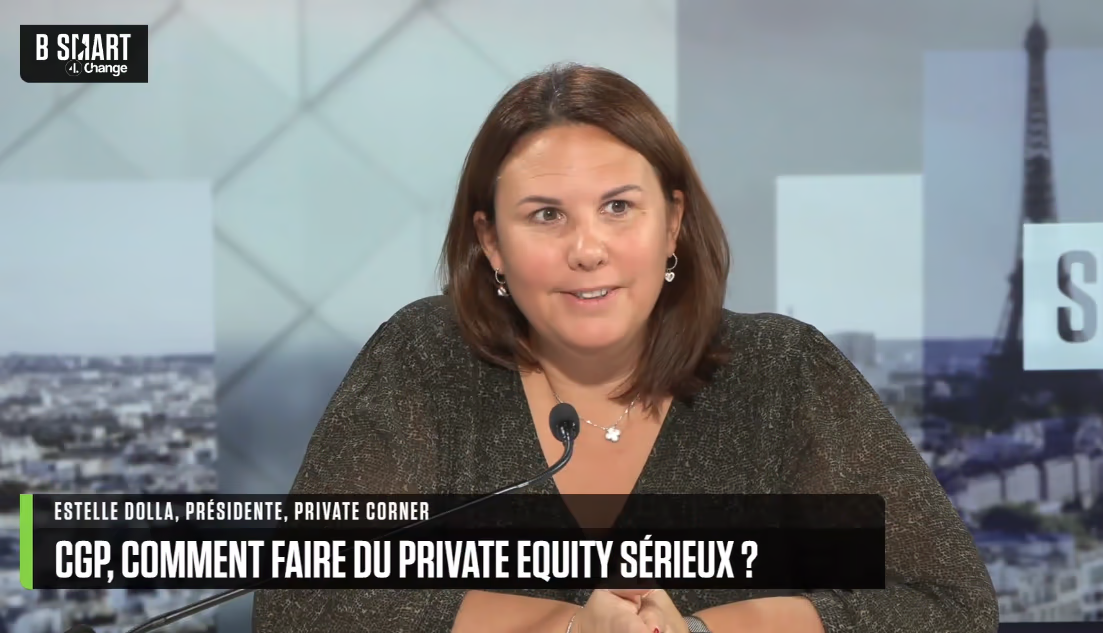
As a guest on the BSmart show, Estelle Dolla, President of Private Corner, outlined the key principles for offering "serious" private equity without necessarily being a specialist, in order to integrate private markets sustainably into private clients' portfolios.
Before proceeding, listen to the full discussion.
Relying on External Expertise
It is imperative to surround oneself with the right partners. A wealth management professional cannot, in isolation, monitor markets, analyze funds, compare vintages, and fully grasp performance dynamics.
The challenge, therefore, is not to become a Private Equity expert oneself, but to leverage a platform or a specialized partner capable of handling the engineering and rigorous fund selection.
Building Allocations with "Pure Bricks" in Open Architecture
There is no "one-size-fits-all" solution; sound advice lies in the ability to construct a bespoke allocation. A "building block" approach is highly recommended.
A proven methodology involves structuring the allocation using a Core / Satellite approach:
- Portfolio Core: Proven strategies that are highly diversified, visible, and stable.
- Satellite Funds: Strategies supporting major transitions such as healthcare, technology, and the environment.
This method ensures optimal diversification, whether geographical, sectoral, or by vintage year.
Prioritizing Education and a Step-by-Step Approach
One cannot approach private markets without pedagogy. Before proposing a product, it is crucial to explain the specific mechanisms of private assets and their inherent risks, notably:
- Capital calls;
- The J-curve effect;
- Illiquidity.
Manager selection is essential! At Private Corner, this selection is at the heart of our craft, and we select only those GPs who have demonstrated their ability to navigate through economic cycles.
Private markets must be understood over the long term. Only once the investor is familiar with this specific asset class can their financial advisor progressively guide them toward more specific themes or specialized managers.
Approaching Private Markets over Time: A Stock and Flow Logic
Private equity should not be viewed as an opportunistic investment: it must be part of a patrimonial construction logic, planned over several years.
A professional approach specifically involves:
- Diversifying entry points over time;
- Smoothing exposure to economic cycles;
- Planning the client's future savings flows;
- Progressively building a multi-vintage portfolio.
This discipline largely explains the structural outperformance of Private Equity.
The Advisor as the "Family Doctor" of Wealth
Faced with the democratization of private equity and the current supply shock, the advisor's value added does not lie in simple access to the product—private equity is no longer a rare commodity.
In our view, the advisor must act as a "family doctor" for the client's wealth, capable of maintaining perspective, taking a step back, and applying a craftsman's precision to provide all the granularity required by the specificity of each portfolio. It is this personalized approach, anchored in the long term, that allows one to offer "serious" private equity even without being an expert.
FAQ
Why is it necessary to seek support when investing in private equity?
Market complexity, fund analysis, and vintage comparison require specific expertise. A specialized partner allows for the delegation of engineering and rigorous fund selection.
What is the "Core / Satellite" approach?
It is an allocation method consisting of building a stable and diversified foundation (the core) and complementing it with thematic strategies (satellites) such as health or technology to seek alpha.
Why refer to the advisor as the "family doctor" of wealth?
The role of the advisor extends beyond providing access to products. They must provide a global diagnosis, plan investments over time, and adapt the allocation to the specific needs of each client, with both perspective and precision.