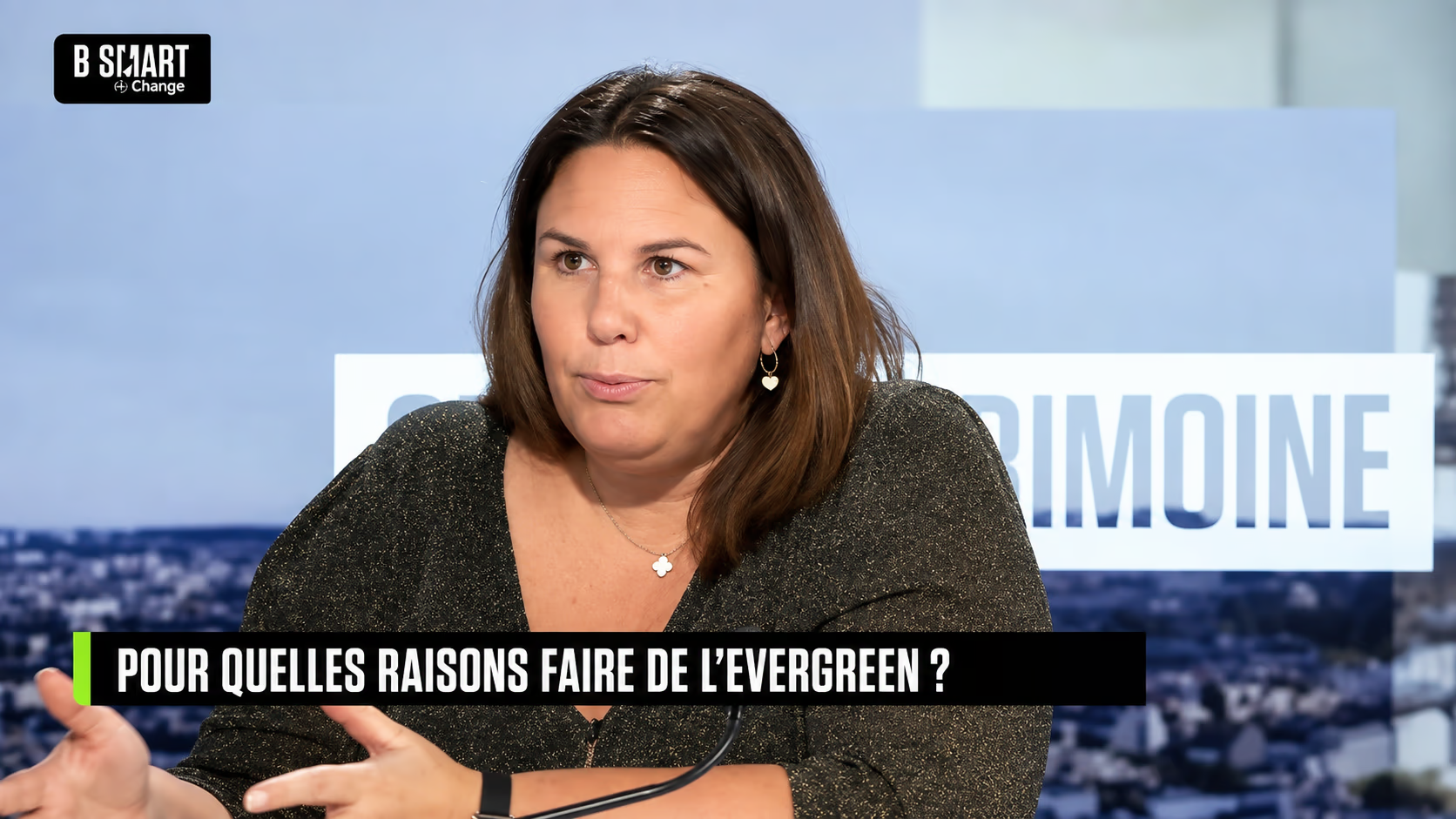
Estelle Dolla, President and Co-founder of Private Corner, was invited by Marc Fiorentino on C’est Votre Argent on BFM Business to discuss the role private assets should play in wealth management allocations in 2026.
Before going any further, listen to the full interview .
Private assets as a structuring asset class
Private assets encompass all investments made outside public equity markets. They notably include:
- private equity, through equity investments in private companies
- private debt, which involves directly financing companies outside the traditional banking system
- real assets, such as infrastructure
Together, these components make private assets a deep, diversified and structuring asset class in portfolio construction.
Today, investing in private equity through an AMF-regulated platform provides access to institutional-grade funds that were previously reserved for professional investors, while benefiting from a structured and secure framework.
Three structuring dynamics shaping 2026
The first is the renewed appetite for yield. In the current interest-rate environment, the search for performance is once again central. Private assets appear more relevant than ever within financial allocations, even though investing in private assets involves risks, notably capital loss and illiquidity.
The second dynamic relates to the upcoming wave of business successions. According to a Bpifrance study, nearly 370,000 companies in France are expected to change hands in the coming years . This succession wave creates a massive need for capital to finance the real economy.
Finally, the third dynamic lies in the fact that, globally, 90% of companies are not publicly listed. Limiting investments to public markets therefore means missing out on a substantial share of value creation that takes place upstream.
In this context, two key convictions emerge and form the foundation of our approach.
Private assets are a craft requiring expertise
Our first conviction is that investing in private assets is a craft that requires precision and expertise. Private markets are, by nature, heterogeneous, and performance dispersion between managers can be significant, depending on:
- the quality of investment teams,
- the rigor of investment processes,
- the ability to identify the right entry points.
In this environment, guidance is essential. Financial advisors play a central role, akin to family doctors of wealth management, capable of building long-term allocations aligned with each investor’s life goals.
It is also crucial to understand how private equity performance is measured , using specific indicators such as IRR or investment multiples.
A structured, transparent and balanced allocation
Our second conviction is the need for a structured, transparent and balanced allocation. Integrating private assets into portfolios requires a rigorous construction framework.
An effective allocation is built around:
- a diversified and resilient core portfolio,
- complemented by targeted satellite allocations designed to activate specific performance drivers.
This approach allows private markets to be integrated in a controlled manner, without disrupting the overall balance of the portfolio.
Private assets as a diversification pillar in 2026
Private assets are set to become a key diversification pillar in 2026, supporting robust portfolio allocations—provided they are selected with discipline and integrated into a coherent global strategy.
The objective is not to oppose public and private markets, but rather to make private assets a diversification pillar in service of resilient allocations.
Private Corner is a portfolio management company authorized by the French Financial Markets Authority (AMF) on 05/11/2020 under number GP-20000038. Investing in private assets involves risks, including capital loss and illiquidity.