
After a decade of rapid expansion, private markets are entering a new phase of development. Growth should continue, but in a more demanding environment, where asset quality, investment discipline and managers' ability to create value will matter more. In its study Private Markets in 2031: Spotlight, published in 2026, Preqin (BlackRock) expects global alternative assets to grow by 8.5% a year between 2026 and 2031. Five key trends for wealth managers, family offices and private banks.
Our team supports wealth managers, family offices and private banks in fund selection.
1. Private markets in 2031: over $34 trillion in assets under management
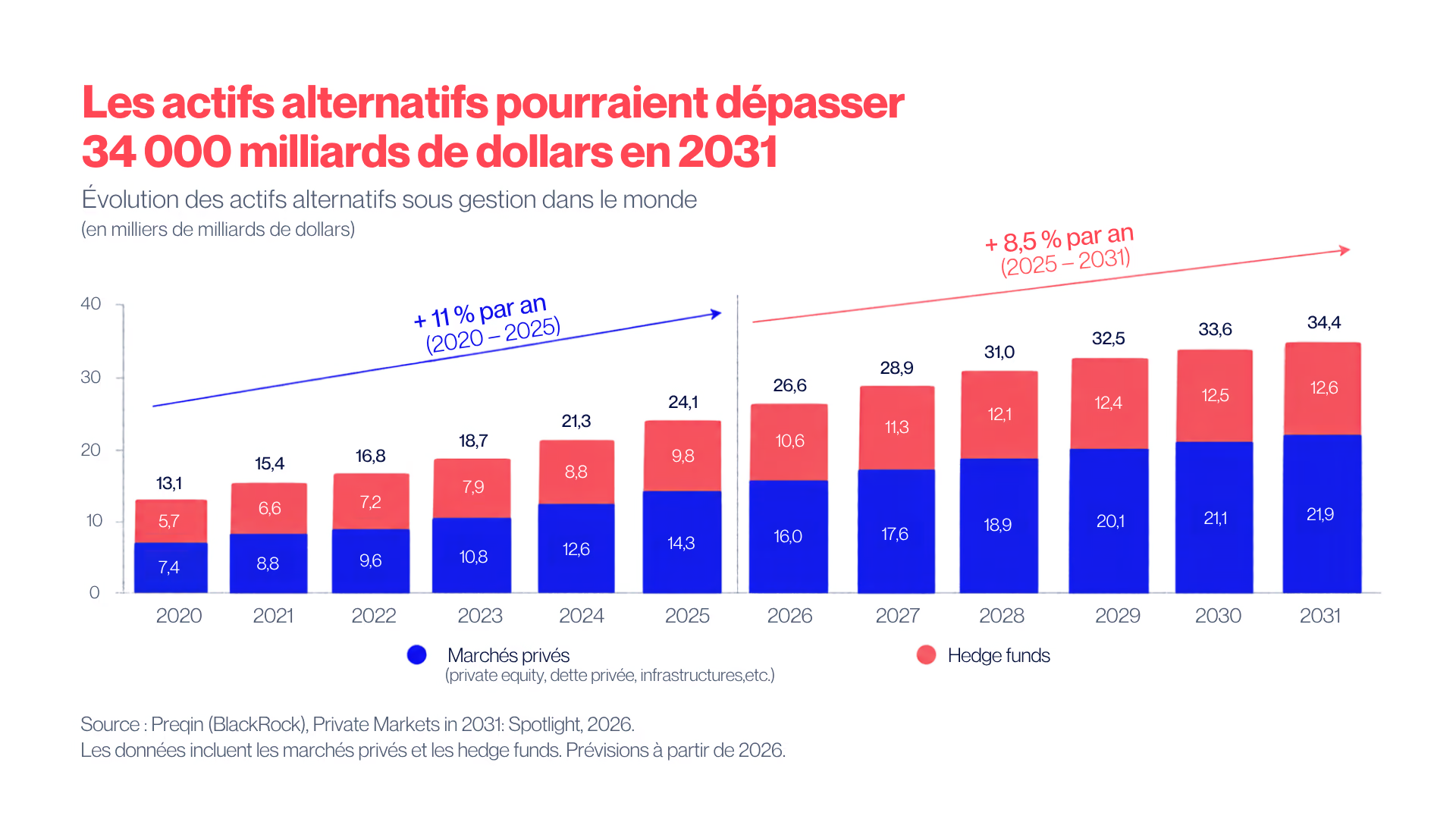
It is one of the headline figures in Preqin's forecasts: alternative assets could exceed $34 trillion in global assets by the end of 2031. Their average annual growth should reach 8.5% between 2026 and 2031, compared with 11% over 2020-2025. A relative slowdown, then, but certainly not a halt in growth. Scope note: this "alternative assets" category includes hedge funds and is therefore broader than private markets assets alone.
Several structural trends continue to support the development of private markets:
- the growing use of private financing by companies, which lets them fund their development outside public markets;
- investment needs linked to digitalization and the energy transition, which mobilize considerable capital;
- the rise of artificial intelligence, which opens up new areas of value creation;
- the diversification of financing solutions, which widens the scope of private markets.
This confirms the growing role of private assets in allocation strategies, well beyond traditional private equity alone.
Key takeaway
Private markets keep expanding, but are entering a more mature and more selective phase of growth.
2. Private equity outlook for 2031: distributions gradually return
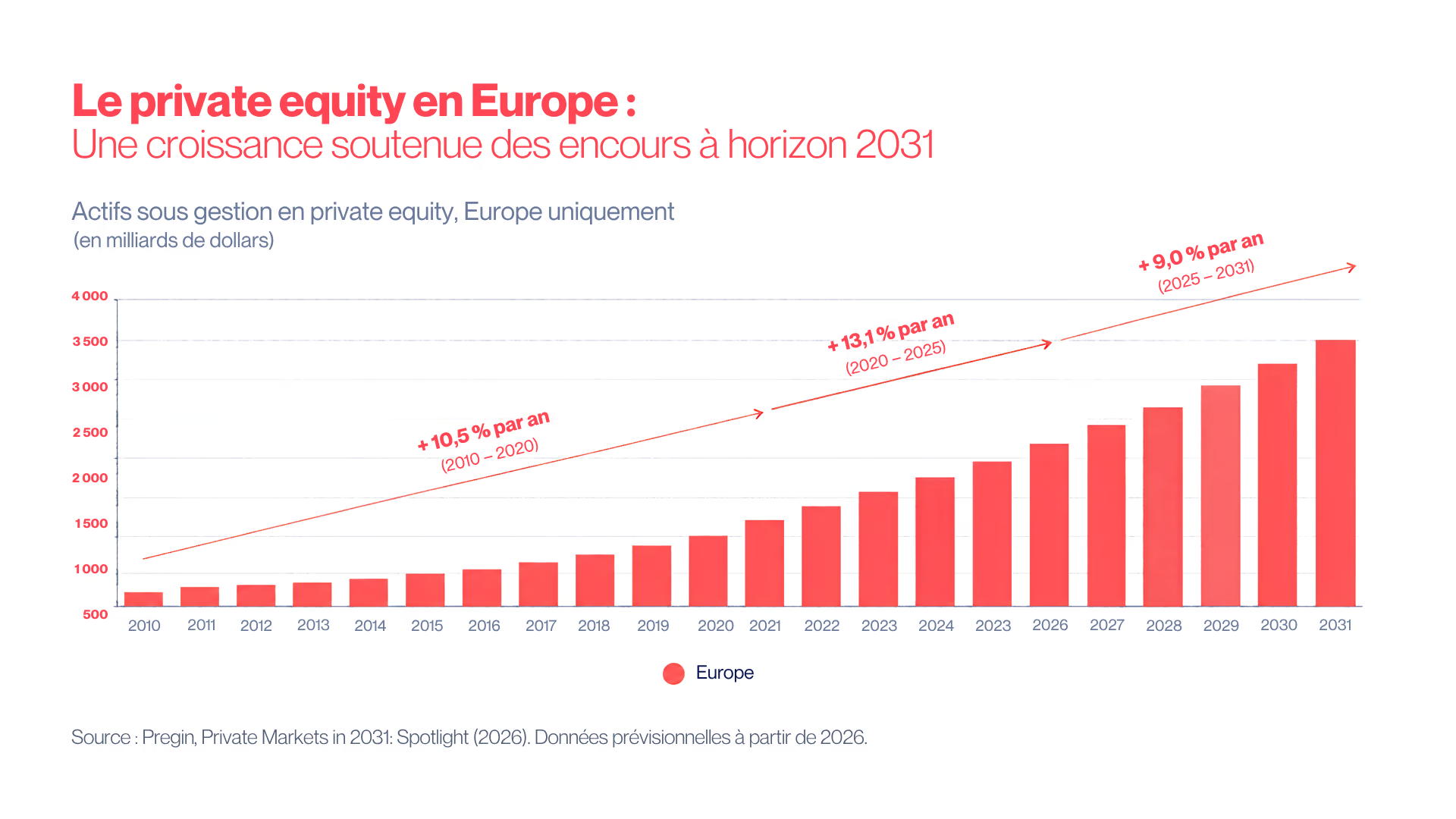
After several years marked by slower exits and distributions, Preqin expects a gradual improvement in the private equity market. Assets could grow at an average annual rate of 9% between 2026 and 2031, to reach about $11.5 trillion.
This recovery rests on one essential factor: the normalization of exits and the return of distributions to investors. Distributions are not only a liquidity issue. They also determine institutional investors' ability to make new commitments and rebalance their portfolios.
Preqin identifies two strategies likely to grow particularly fast:
- secondary private equity, which allows investors to acquire stakes in existing funds or assets, often at a later stage of their life cycle;
- growth equity, driven notably by the development of innovative and technology companies.
The secondary private equity market plays a particular role in this shift. It provides liquidity solutions to existing investors while allowing buyers to gain exposure to portfolios that are already built. The recovery in fundraising could become more significant from 2030, provided exits improve broadly enough.
Key takeaway
The private equity outlook remains favorable over the long term, but the recovery in distributions, valuation discipline and quality of execution will be decisive.
Discover the funds currently open for subscription.
3. Private debt in 2031: over $5 trillion and the rise of evergreen funds
Private debt should keep growing to exceed $5 trillion in assets under management by 2031, according to Preqin. This growth comes with a change of context, however. After a decade of rapid expansion, the asset class has to cope with tighter credit spreads, potentially lasting high interest rates and closer attention to borrower quality.
In this environment, three factors become essential:
- the rigor of lending criteria;
- the quality of risk analysis and monitoring;
- managers' ability to limit potential losses if the economic cycle deteriorates.
To dig deeper into these mechanisms, read our guide to private debt strategies.
Evergreen funds, a growth engine for private debt
Another major shift identified by Preqin: evergreen funds are expected to be one of the main growth drivers of private debt by 2031. These open-ended vehicles offer subscription terms and, under conditions, redemption terms that differ from those of traditional closed-end funds. They do not, however, remove the risk of capital loss or the liquidity constraints of the underlying assets. Our guide to how evergreen funds work explains these mechanisms.
At the same time, the market is diversifying beyond traditional direct lending, notably toward asset-backed finance and investment grade corporate credit. This widens the private debt universe, but also makes it more necessary to tell strategies apart by risk profile, quality of collateral and borrower characteristics, which points to the importance of manager selection.
Key takeaway
The growth of private debt and evergreen funds comes with higher requirements for manager selection, structuring and credit risk management.
4. Infrastructure in 2031: Europe could overtake North America
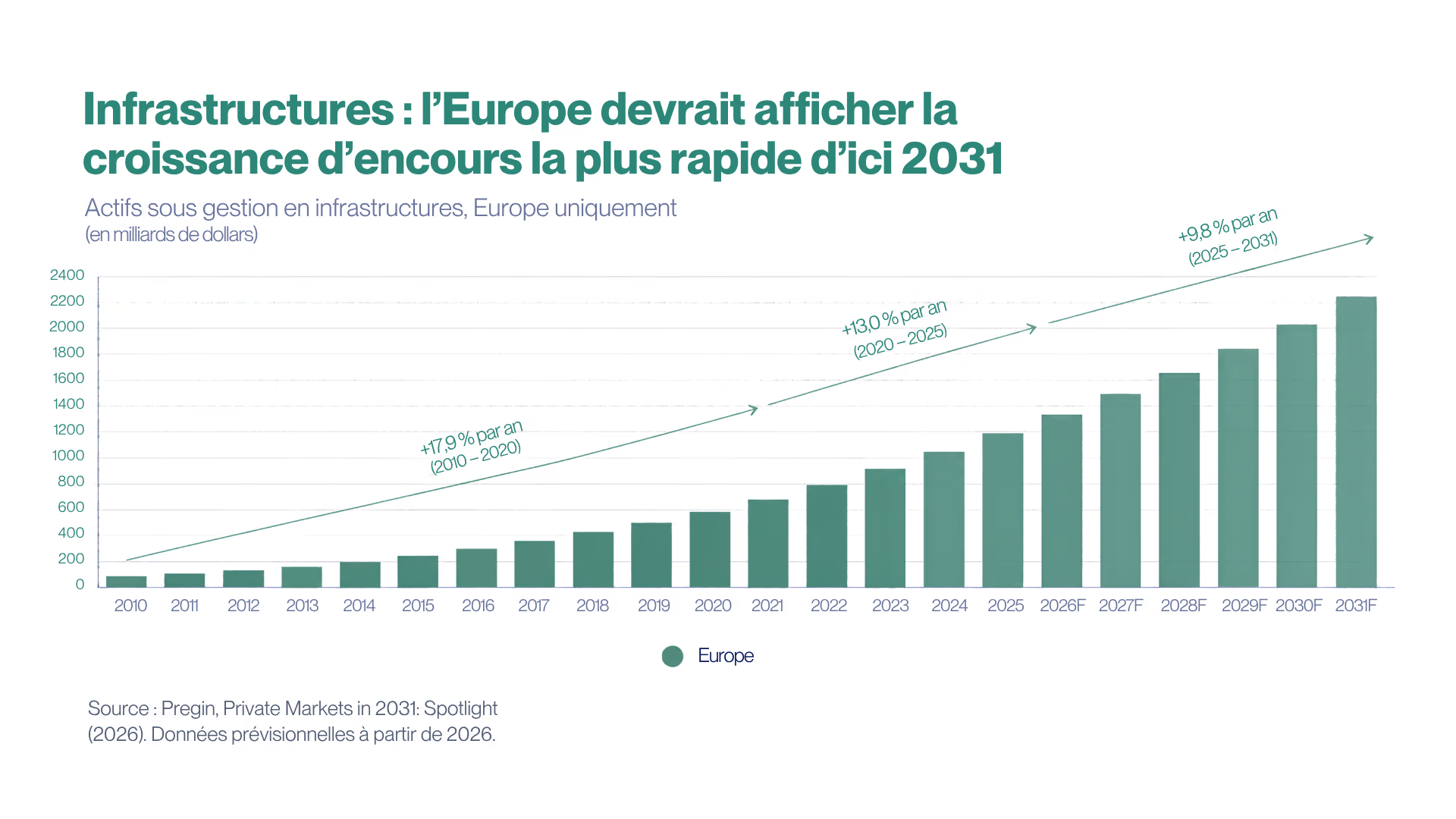
It is one of the most interesting projections in the study for European private markets. By 2031, Europe could slightly overtake North America in infrastructure fund assets. Preqin expects global annual growth of 9.8% for this asset class between 2026 and 2031. Three structural drivers support this momentum.
Energy transition and security of supply
Rising electricity needs, the modernization of power grids and energy security challenges call for considerable investment.
Digitalization and digital infrastructure
Data centers, connectivity and digital infrastructure go hand in hand with the spread of artificial intelligence and growing computing needs.
Supply chain resilience
Industrial and geopolitical shifts are increasing investment needs in strategic infrastructure.
These three drivers place infrastructure in long-term investment cycles. Their development will not be uniform, however: it will depend on regions, strategies and managers' ability to deploy their capital effectively.
Key takeaway
Infrastructure benefits from structural investment needs, with a potentially growing share for Europe in global assets.
5. Venture capital and artificial intelligence: a new growth cycle?
For Preqin, venture capital could undergo a profound transformation by 2031, driven notably by the adoption of artificial intelligence. Falling model costs, productivity gains and the growing integration of AI in companies open up new prospects for value creation.
The study highlights in particular the potential of the application layer of artificial intelligence, meaning companies that build concrete uses on top of these technologies. Global venture capital assets could grow by about 9.2% a year between 2026 and 2031. Even so, Preqin does not expect a rapid return to the exuberance of 2021-2022.
The recovery in fundraising will depend notably on improved distributions and the gradual return of institutional investors. North America should keep its dominant position in this market. Artificial intelligence could therefore support a new innovation cycle, without removing the challenges of valuation, profitability and company selection.
Key takeaway
AI is a powerful driver of transformation for venture capital, but value creation will remain closely tied to the strength of business models and to investment discipline.
Conclusion – Private markets in 2031: what implications for private asset allocation?
Beyond the growth forecasts, the Preqin study highlights an important shift: private markets are becoming larger and more diversified, but also more demanding. The different asset classes do not respond to the same economic drivers or the same liquidity dynamics.
Private equity remains dependent on the recovery in exits. Private debt calls for greater vigilance on credit quality. Infrastructure rests on long-term investment needs, while venture capital remains particularly sensitive to technology cycles and valuations.
For wealth clients, this diversity strengthens the case for a structured allocation to private assets, combining strategies according to their own characteristics: investment horizon, risk profile, pace of capital calls and distributions, geographic exposure and sources of value creation. From this perspective, the point is not to try to time the best moment to invest, but to understand how strategies complement each other and where each fits within an overall allocation.
The question is therefore not only how much private markets will grow by 2031, but how to build a coherent exposure to strategies whose trajectories will be increasingly differentiated. At Private Corner, we are convinced that this shift reinforces the importance of selection expertise, structuring quality and transparency in monitoring investments.
A conversation with our team to build a coherent exposure to these strategies.
Private markets in 2031: key figures from Preqin's forecasts
| Indicator | Forecast, end-2031 |
|---|---|
| Global alternative assets | Over $34tn |
| Annual growth of alternative assets | 8.5% |
| Annual growth of private equity | 9.0% |
| Private debt assets | Over $5tn |
| Annual growth of infrastructure | 9.8% |
| Annual growth of venture capital | 9.2% |
| European infrastructure | Assets potentially above those of North America |
Growth rates are forecast average annual rates over 2026–2031; amounts are expected assets at end-2031.
(Source: Preqin (BlackRock), Private Markets in 2031: Spotlight, 2026. Summary and editorial analysis by Private Corner. Forecasts expressed in nominal terms.)
FAQ – Private markets in 2031
What growth is expected for private markets by 2031?
According to Preqin, global alternative assets could exceed $34 trillion by the end of 2031, with average annual growth estimated at 8.5% between 2026 and 2031. This forecast includes hedge funds and therefore does not relate exclusively to private markets assets.
Which private equity strategies could grow fastest by 2031?
Preqin points in particular to secondary private equity and growth equity as segments likely to grow relatively fast. Their development will depend notably on a recovery in exits, distributions and fundraising.
Why could Europe become a major infrastructure market by 2031?
The energy transition, security of supply, digitalization and supply chain resilience all support the investment outlook. According to Preqin, assets in European infrastructure funds could slightly exceed those in North America by the end of 2031.
How large could private debt become by 2031?
According to Preqin, private debt assets could exceed $5 trillion by 2031. Evergreen funds are expected to be one of the main drivers of this growth, without removing the risk of capital loss or the liquidity constraints of the underlying assets.
Will venture capital return to its 2021-2022 levels?
Preqin expects global venture capital assets to grow by about 9.2% a year between 2026 and 2031, driven notably by artificial intelligence. The study does not, however, forecast a rapid return to the exuberance of 2021-2022.
Projections are subject to uncertainty and are not guaranteed results. Disclaimer: this document is for information purposes, is intended for wealth management professionals and is issued by Private Corner, an asset management company authorized by the AMF (GP-20000038). It does not constitute investment advice or a recommendation to subscribe. Investments in private assets carry, in particular, risks of capital loss, illiquidity and valuation. Past performance and forecasts are not a guide to future performance.